Treasure Hunt: Bathurst – The camp that powered the modern world
After the launch of The Great Canadian Treasure Hunt, explorers from coast to coast have been digging into Canada’s mining past – […]
At 1:15 p.m., the lights die inside Mill No. 3 and the building starts to talk. A wash of sparks jumps from a century-old compressor, air drills bark, the floor shudders. BOOM! – the museum’s multisensory show – doesn’t pretend you’re at a theme park; it invites you inside a 20-storey machine that once fed a copper-hungry world. Five decades after the mine closed, this is the bold open to a different kind of origin story: how a remote company town learned to use its powers for good.
As Britannia Mine Museum turned 50 last year, that “superhero origin” frame isn’t just branding – it’s a useful way to read a site that keeps reinventing itself, the museum’s director of programs and guest experience, Derek Jang, said in an interview.
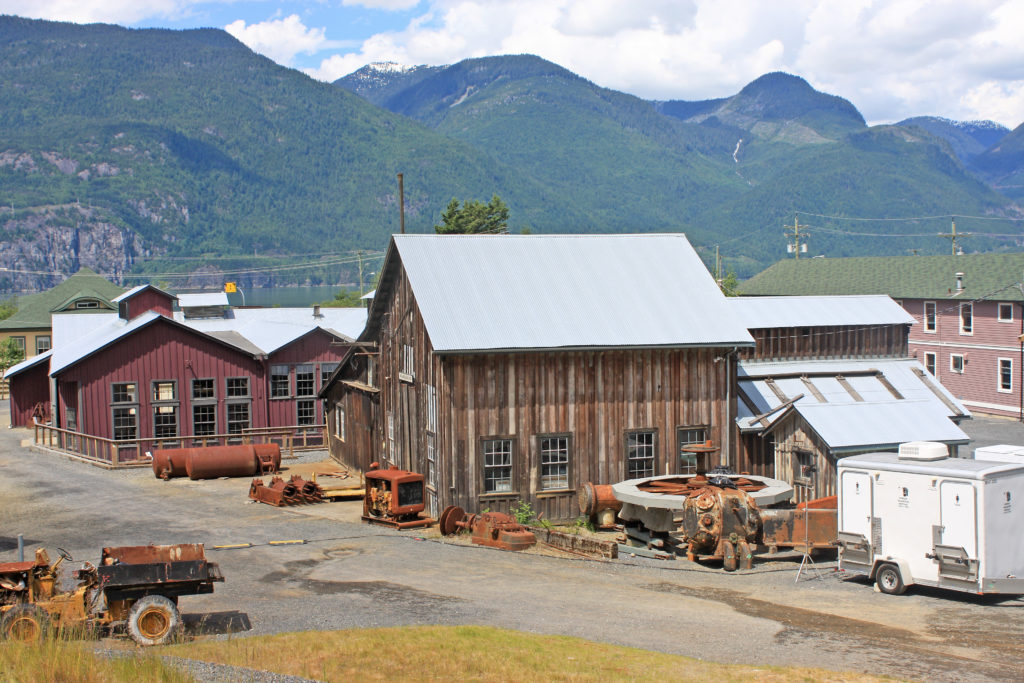
Set against cliffs above Howe Sound in B.C.’s Sea to Sky corridor, this former company town is now a museum. For decades, it has worked to change its troubled industrial past into an interactive classroom for technology, history and environmental recovery.
“It’s our superhero origin story,” Jang said. “We have an obligation to connect with people who don’t think mining has anything to do with them – then show them that it’s embedded in their phones, their vehicles and their grid.”
Born from early planning that began even before the mine shut in 1974, Britannia’s reinvention combines spectacle with scholarship. An underground train takes visitors into the mountain; a 20-storey concentrator mill glows to life in BOOM!, a live-action show; and a working water treatment plant teaches hard lessons about acid rock drainage and remediation.
The museum welcomed about 80,000 visitors last year and is on track to outdo that this year, welcoming thousands of students from kindergarten through university.
The Britannia mine’s story arc mirrors Canadian mining’s own, according to Yang. From frontier ingenuity, finding community in remote outposts and wrestling together through tragedy; then an eventual pivot to science-based stewardship. “People were preparing for this transformation in the 1960s,” Jang explained. “When the resource ran out, they asked: what do we want this place to become?”
Jang’s “origin” metaphor lands because Britannia’s pivot didn’t start with a ribbon cutting. Civic foresight and centennial-era organizing in the 1960s formalized the museum’s official opening on May 19, 1975, then as the B.C. Museum of Mining. It coincided roughly with the mine’s closure. People scripting a second act for the site turned an industrial site into a public-spirited “superhero,” according to Jang. And the speed of the change mattered, he added.
Where many company towns fade to ghost towns, Britannia’s community story stayed visible and, crucially, useful. Today’s museum is governed as a non‑profit with a mandate to interpret the industry’s past, present and future for a general audience.
Long before the museum era, the story begins in the late 1880s, when prospectors working out of Texada Island pushed into the Squamish area searching for gold. One of them, Alexander Forbes, staked early claims and is widely credited as the mine’s founder. In 1898, trappers turned up sulphide-rich copper in mineralized schist; a rush of claims followed, and the Britannia Mining & Smelting Company coalesced soon after. By 1904, production was underway.
Scale arrived quickly. Over seven decades, miners drove more than 160 km of underground workings and completed roughly 108 km of diamond drill holes, ultimately extracting about 750 million lb. of copper from 35 million tonnes of ore. At its 1920s peak, Britannia ranked among the British Empire’s largest copper producers.
The town boomed, faltered and rebuilt through epidemics, floods, slides and strikes, then wound down to its final closure in November 1974 – just as volunteers and civic champions were sketching a future beyond extraction.
Today, the site reads like a layered graphic novel. There’s the immersive underground tour – compressed air hissing through historic drills – and the glass-walled cathedral of Mill No. 3. Inside that mill, BOOM! leans into theatre: sparks, sound and story, not as nostalgia, but as a question – what happens to big industrial structures when their original purpose ends? “The answer at Britannia is ‘reuse’,” Jang explained.
In 2010, a multi‑year redevelopment turned the campus into a modern visitor experience, while retaining the site’s heft and texture.
Isolation forced creativity. Company-built amenities – libraries, a movie theatre, club rooms and billiards, tennis courts, a bowling alley and a heated outdoor pool – gave families reasons to stay. The social calendar brimmed with sports days, theatre, dances and the Copper Queen pageant, where a jewel-laden crown (yes, you can still see it) conferred bragging rights.
These investments came to soften the harsh reality of living and working in high-risk mine sites, Jang said. A rock and snow slide in 1915 destroyed the higher-elevation Jane Camp, killing dozens. A flood and fire in 1921 forced further rebuilding. Those episodes shaped a company town determined to be more than bunkhouses and shift whistles.
For most of the mine’s life, Britannia Beach was reachable only by water; people and supplies came by boat to the company wharf, then rode incline rail up to work or to the higher-elevation townsite at Mount Sheer. A proper road linking the Beach and Townsite wasn’t completed until 1952. Today, that sense of remoteness is hard to imagine as visitors glimpse the stepped façade of Mill No. 3 right off Highway 99.
Jang’s team has leans into that social history to keep those human stories alive. A new “Step back in time” program invites returning residents and their families to locate themselves in the landscape – even when former townsites like Mount Sheer have been reclaimed by forest.
Britannia’s technical legacy travelled far. The operation helped pioneer froth flotation to recover fine sulphide minerals – an innovation later adopted worldwide. Museum sources credit Canadian engineer Jack Ross with recognizing Britannia’s leadership in the field.
The process has an intriguing backstory: Carrie Everson, a Chicago chemist, patented an early concentration method in 1886 but never received lasting credit; her role is now being re-examined by historians. For today’s students, it’s a reminder that mining history is also a history of ideas – and of who gets recognized for them, Jang pointed out.
If the origin story hooks visitors, the environmental chapter keeps them, Jang said.
Britannia’s water treatment plant is a full-scale classroom on remediation – lime slurry, clarifiers, pH and sludge – and a reasoned counterpoint to nihilism about damaged places. The science isn’t abstract: salmon and humpbacks again ply Howe Sound, and students use Britannia as a case study in applied earth science, engineering and policy.
“Returning waters to pre‑industrial conditions may be impossible,” Jang said. “But revitalizing food chains and making habitats usable again – that’s meaningful work for this generation.”
The museum is amid its busiest season in its busiest year. One of the family and fan-favourite attractions is the site’s panning pavilion. It’s catnip for families and a gateway to mineral literacy, Jang said. Staff stock the troughs daily with fake and yes, real gold flakes.
On a more serious level, Britannia’s content mix – technology history, social narratives, environmental engineering – is strategic, Jang said. It builds broader coalitions than “hard‑hat tourism” alone.
Executives considering social license and youngsters exploring the sector can look to Britannia. It shows how an extractive site can transform into a cultural asset, an educator and a supportive neighbour.
It also models a pragmatic funding mix. The museum is a nonprofit that largely makes its own luck through admissions, memberships, programs and retail. That revenue independence encourages an entrepreneurial culture while keeping the institution focused on public interest storytelling, according to Jang.
Jang says the next stage leans on two strengths: space and partnerships. Much of the campus footprint remains under-interpreted, with large machines and back-of-site areas awaiting reinforcement and curation.
As the Sea to Sky region grows, including the new Britannia Village, the museum plans to include more stakeholder views and new exhibits. This will keep the annual-pass experience relevant for locals while enhancing its status as a national historic site.
Remediation is ongoing. Full ecological restoration in Howe Sound is a long game, Jang explained. Not every historic area can be safely opened to foot traffic. And as a magnet for tourism, Britannia shares the corridor with heavy seasonal congestion.
“Yet those constraints sharpen the museum’s mission: focus on safe access, rigorous interpretation and programs that link the mine’s past to the resource decisions households, companies and governments face today,” Jang said.
If superhero stories are about power used responsibly, Britannia’s first 50 years show how an industry can be remembered honestly, Jang said. Origin stories aren’t endings. Britannia’s next issues are already on the storyboard; the arc bends toward providing more context, more collaboration and having more young minds leaving with wet cuffs and new questions.
“The 50th marks not an ending but an inflection point,” said Jang, “The hero comes into its power and the next 50-year chapter begins.”