Treasure Hunt: Bathurst – The camp that powered the modern world
After the launch of The Great Canadian Treasure Hunt, explorers from coast to coast have been digging into Canada’s mining past – […]
The hunger for uranium won’t abate anytime soon as the heavy metal’s spot price hovers near two-year-highs, but some geologists warn easy-to-mine reserves are shrinking.
Enter what may sound unusual: mining uranium from ocean water. Several researchers and entrepreneurs are developing approaches that could upend a global uranium mining industry valued at $12.4 billion using a price of $80 per pound.
“We want to prove that we can produce uranium cost-competitively and much more rapidly than land-based mines,” said Canon Bryan, the CEO of Austin, Texas-based SuperCritical Minerals, one of a few companies developing seawater uranium mining. SuperCritical has Department of Energy (DOE) backing for a demonstration plant by September and intends to deploy commercially in 2027, Bryan said.
The research is fuelling debate on whether ocean uranium mining can be financially viable to supply a globe shocked by climate change into re-embracing nuclear power as a low-emission energy solution. Supporters contend this is just the beginning of a fast-moving shift in recovering not just uranium from the water, but other minerals, too. Doubters say sourcing from seawater will take decades.
David Talbot, managing director of Toronto-based Red Cloud Securities, says he is skeptical about the promise and potential.
“I really don’t think we are at that stage yet,” he said by phone. “For terrestrial mining of uranium, porosity and permeability are much more important, and with seawater the grades are so low, the equipment and process would need to be so sensitive and I don’t know how long absorption would take.”
The spot uranium price hit $101.55 on Jan. 29, the highest since February, 2024. Demand is rising as technology companies such as Meta and Alphabet consider reactors to power data centres for AI and even the Trump administration sees nuclear energy as a cornerstone program.
Utilities and other buyers, such as the Toronto-based Sprott Physical Uranium Trust (TSX: U.U for USD; U.UN for CAD), the world’s largest uranium investment fund, are increasing inventories. The trust is adding yellowcake at its fastest pace since it formed in 2021.
“We’re not going to have enough uranium and other minerals to keep up with that demand,” Andrew Martin, an associate professor of geochemistry from the University of Nevada at Las Vegas, said by phone. “We either need to find alternate resources or we need to extract them more efficiently.”
The current spot price is profitable for established producers, though they mostly secure long-term contracts at prices lower than the spot market. So far, Bryan’s seawater mining concept offers a potential cost of around $67.50 per lb., according to preliminary work.
Some companies mining on land, such as Ur-Energy (TSX: URE; NYSE-A: URG) and Denison Mines (TSX: DML; NYSE: DNN), use in-situ recovery, a leaching method that separates uranium from ore underground and pumps the solution to the surface for extraction. It’s generally less expensive than traditional hard rock mining, doesn’t require the digging of large pits and leaves fewer tailings.
Ur-Energy pegs all-in sustaining costs (AISC) at $39.72 per lb. of uranium oxide from its Lost Creek mine in Wyoming. Denison is forecasting AISC of $16.04 per lb. at the Phoenix deposit on its Wheeler River project in Saskatchewan.
That compares with traditional miner Cameco (TSX: CCO; NYSE: CCJ) at an AISC of about $34 per lb., according to analysts. World-leading producer Kazatomprom (LSE: KAP) in Kazakhstan forecasts an AISC of about $30 per lb. this year. Costs vary according to ore grade, labour expense and other factors.
Bryan said it’s too early to determine capital expenses for a sea mining setup, but he intends to apply for a DOE loan that could reduce borrowing costs significantly for 70% of the expense. The total cost is bound to be lower than on-land producers, he said.
“This is simply due to the low-tech, brute-force nature of the technology,” he said. “It basically consists of the floating platform – cheap – and the fibre – cheap.”
Terrestrial mining for uranium seems relatively stable with major suppliers Cameco in Canada and Kazatomprom leading reserves. The total amount of identified uranium available on land is about 7.93 million tonnes, according to 2024 data from the Organisation for Economic Co-operation and Development’s Nuclear Energy Agency and the International Atomic Energy Agency.
But when turning to what the ocean holds, the comparison is stark: Around 4.5 billion tonnes of uranium reside in the world’s bodies of water, according to DOE studies cited by Stanford University, the University of Chicago and other researchers.
But there’s a catch. Uranium is extremely dilute in water, and salt and other ions cling to anything an electrochemical system lays into the water. The dilution at 3.3 parts per billion makes uranium especially tricky to capture, largely encouraging terrestrial mining companies to continue focusing on land deposits.
Maha Haji, an assistant professor of mechanical engineering at the University of Michigan, has bypassed earlier methods that wasted energy to devise a chemically-treated fibre that can bind with metal ions in the water. It was found to stick strongly to uranium, extracting more than other methods that didn’t use this type of material.
“With the designs we came up with when we published this study in 2019, you could produce uranium at a cost that was similar to what breeder reactions used,” Haji said.
Her research with the specialized fibre material led to a joint research project at the DOE, which attracted the attention of Bryan, CEO of SuperCritical.
“This technology was proven in a lab, but has never had proper systematic engineering done to see if it’s commercially viable,” Bryan said. “That’s where we come in.”
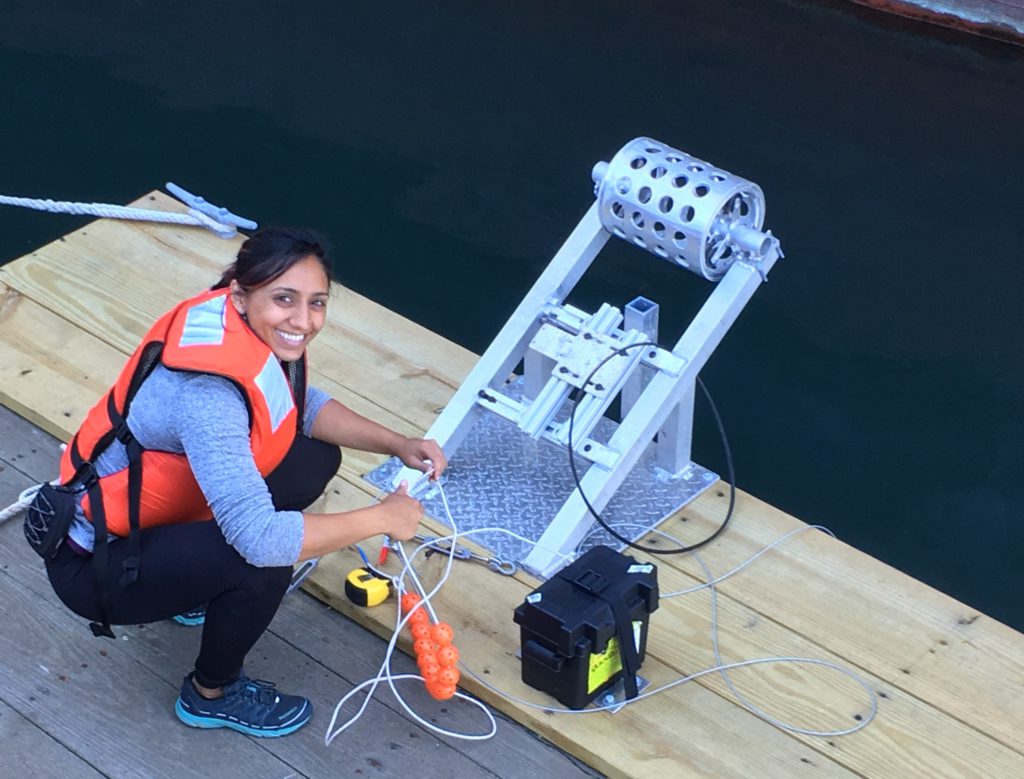
He liaised with DOE researchers, who hold the patent on the fibre technology, to commercialize the research into what will eventually resemble a platform around 1,000 metres long outfitted with a mechanism in the shape of a scrolling curtain. It lowers the fibre material around 300 metres underwater.
Their key challenge, though, is ensuring a huge amount of water interacts with the chemically-treated fibres, a task that used to mean churning water through a mechanism gobbling up a large amount of energy. Instead, Bryan says his team will head out to the Gulf Stream to “leverage the currents and use what is already in the ocean.”
But cost-effectiveness isn’t the only point to consider, Haji said. Terrestrial mining can hurt communities and ecosystems, even release dangerous by-products such as radon that can be hazardous to our health, she said.
“Since we have a vast resource of uranium in seawater, much more than we do on land, we have to take advantage of that opportunity,” Haji said. “There’s a ton of other minerals that are critical to us that we can get from seawater in similar ways.”
Haji’s curtain improves on approaches that pulled uranium from one end of an electrochemical system (and wasted energy on the other end), and two different Chinese methods. One group of Chinese researchers uncovered a new way to pull uranium out of the water using a type of magnet-like technology that conserves energy and effectively “mines” the water for uranium.
Instead of allowing, as usual, one end of this process to waste energy, they used copper to help trigger a reaction that turns uranium into a different solid when experimenting with seawater in a lab. This approach led to at least 85% increased efficiency at picking uranium specifically, even when other metals were 1,000 times more crowded in the water.
“This approach holds a lot of promise, but could it scale effectively, and how costly would it be?” Haji said, noting the difference between success in the lab and out at sea.
Bryan is encouraged by Haji’s progress in the face of naysayers.
“The dismissive attitude of the industry is our superpower,” he said. “There is perhaps understandably some technological lock-in, and fear of the unknown. It is a classic response to innovation, which I have seen over and over and over again throughout my career by the orthodoxy.”